October 23, 2026
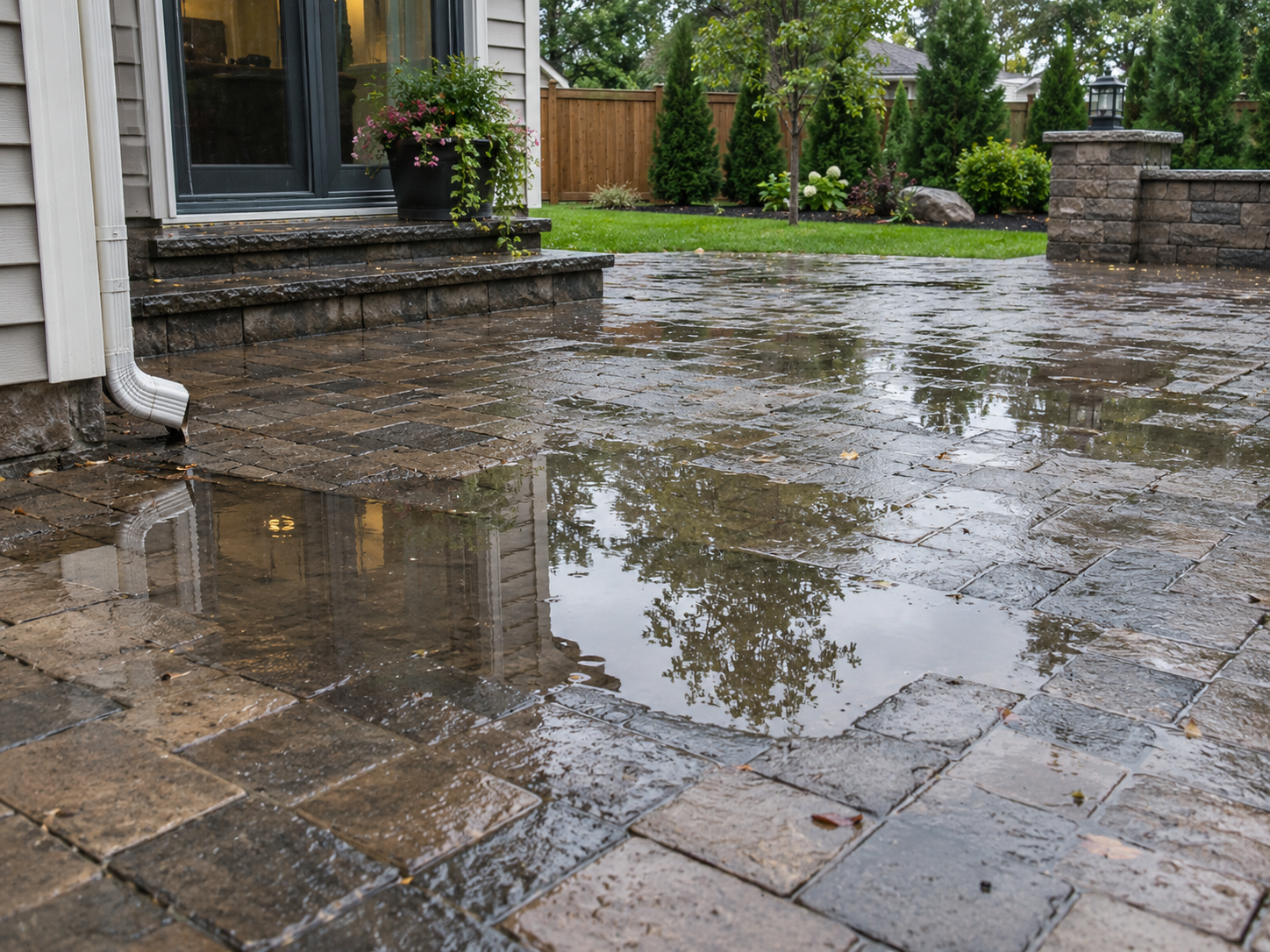
A beautiful patio is great. A beautiful patio that doesn’t turn into a shallow pond every time it rains is better.
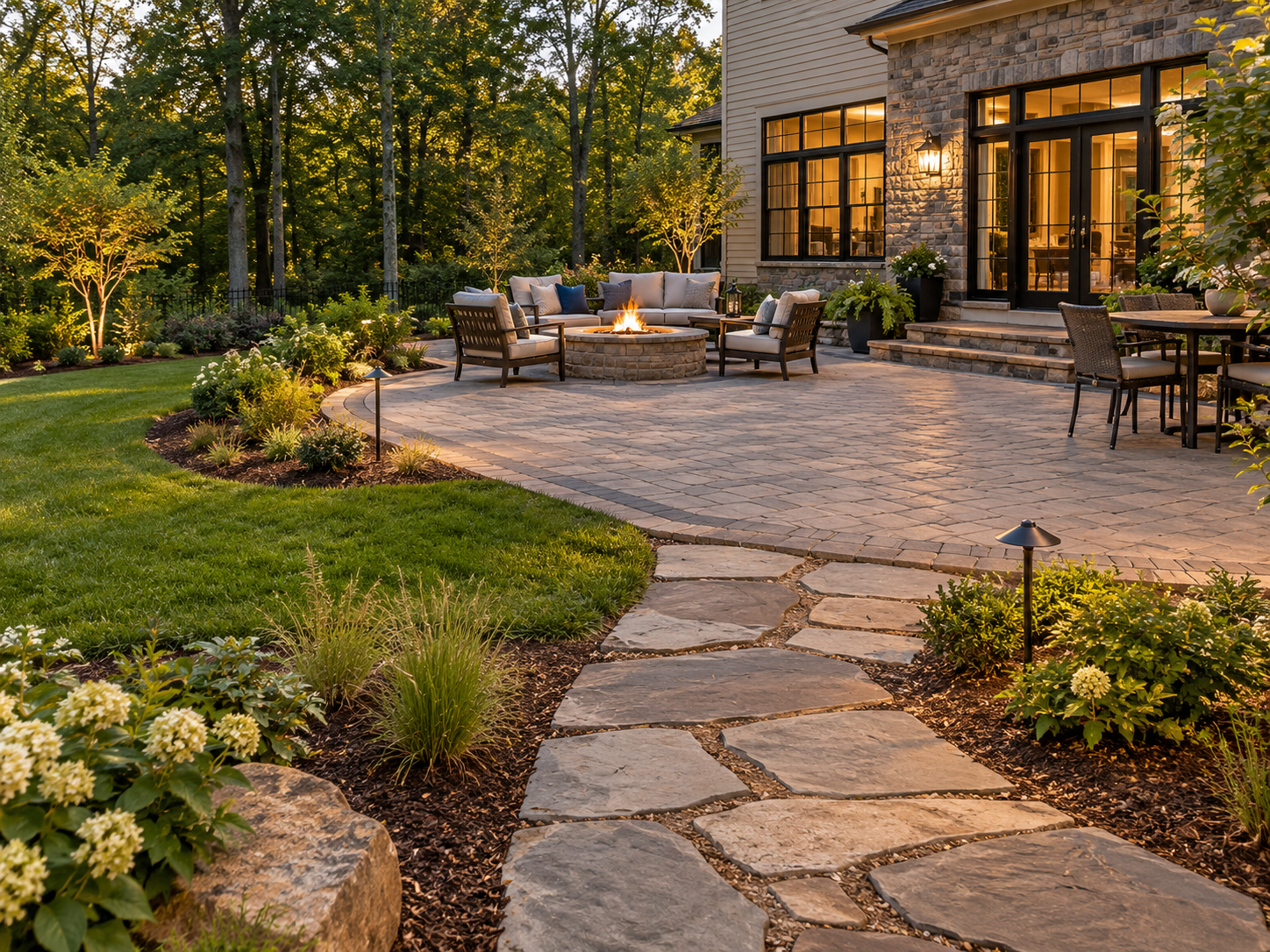
Water is one of the biggest reasons hardscape projects succeed or fail.
Not paver color.
Not border style.
Not whether you chose a herringbone pattern because somebody on Pinterest made it look fancy.
Water.
If a patio isn’t designed to move water correctly, eventually that water is going to find the weak spot.
At Skyline Hardscapes & Premier Outdoor Living, we design and build paver patios, retaining walls, walkways, outdoor kitchens, fire features, and complete outdoor living spaces throughout Roanoke, Salem, Bedford, Smith Mountain Lake, Botetourt County, Lynchburg, Forest, Lexington, Blacksburg, Christiansburg, and surrounding Southwest Virginia communities.
And around here, drainage deserves extra attention.
Why?
Because we have:
- Clay-heavy soils
- Sloped properties
- Hillside homes
- Heavy rain
- Roof runoff
- Downspouts
- Existing concrete
- Driveways
- Retaining walls
- Yards that sometimes seem personally offended by the concept of being level
So before we talk about pretty pavers, let’s talk about where the water is going.
Because water always goes somewhere.
The goal is making sure we decide where.
Why Is Drainage So Important Under a Paver Patio?
A properly installed paver patio is designed as a complete pavement system.
That includes:
- Native soil
- Base material
- Bedding layer
- Pavers
- Joint material
- Edge restraint
- Surface slope
- Drainage
Every one of those components affects the others.
If water collects underneath or around the patio, problems can eventually include:
- Settlement
- Low spots
- Paver movement
- Joint washout
- Edge failure
- Erosion
- Soft subgrade
- Standing water
- Water against the foundation
- Freeze-thaw movement
That’s why patio drainage isn’t something we figure out after the pavers are installed.
It should be part of the design before excavation starts.
Should a Paver Patio Be Completely Level?
No.
And this is one of the most common misunderstandings homeowners have about patios.
A patio should look level.
It should feel level.
Your chair shouldn’t feel like it’s trying to roll into the flower bed.
But the surface generally needs a slight pitch so rainwater moves toward an appropriate drainage area.
If you put a level on the patio and it is absolutely dead flat in every direction, that usually isn’t something to celebrate.
Water doesn’t care how pretty the patio is.
It needs somewhere to go.
How Much Slope Does a Paver Patio Need?
There isn’t one slope that is correct for every project, but patios are generally designed with enough pitch to move surface water without making the finished area uncomfortable to use.
The exact slope depends on:
- Patio size
- Existing grade
- House elevation
- Door thresholds
- Yard elevation
- Nearby retaining walls
- Drainage outlets
- Existing concrete
- Driveways
- Walkways
- Landscape areas
The goal is not:
“Make it slope.”
The goal is:
“Make it drain correctly.”
Those are not always the same thing.
You can have plenty of slope and still send the water somewhere terrible.
For example:
Directly toward the house.
Which is frowned upon.
Which Direction Should a Patio Slope?
Whenever possible, surface water should move away from the home and toward an appropriate drainage location.
That might mean toward:
- The lawn
- A lower landscape bed
- A swale
- A drain
- A collection system
- Another approved discharge point
The existing property determines the answer.
This is why we look at the entire site when planning a hardscape project.
You cannot design drainage properly by staring only at the rectangle where the patio will go.
Water may be coming from fifty feet uphill.
A downspout may be dumping roof runoff beside the patio.
The neighbor’s yard may be higher.
The driveway may direct water toward the backyard.
All of that matters.
Roanoke Clay Makes Patio Drainage More Interesting
And by “interesting,” we mean annoying.
A lot of properties throughout Roanoke and Southwest Virginia have clay-heavy soils.
Clay tends to drain more slowly than sandy or highly permeable soil.
That becomes important because the patio doesn’t exist in a laboratory.
It sits on whatever Mother Nature decided to put underneath your house.
If rainwater enters the pavement system and reaches slowly draining clay, it may not disappear very quickly.
That doesn’t mean you can’t build a paver patio on clay.
Obviously.
We’d be out of business pretty fast.
It means the installation needs to account for the soil.
That may involve:
- Proper excavation
- Subgrade preparation
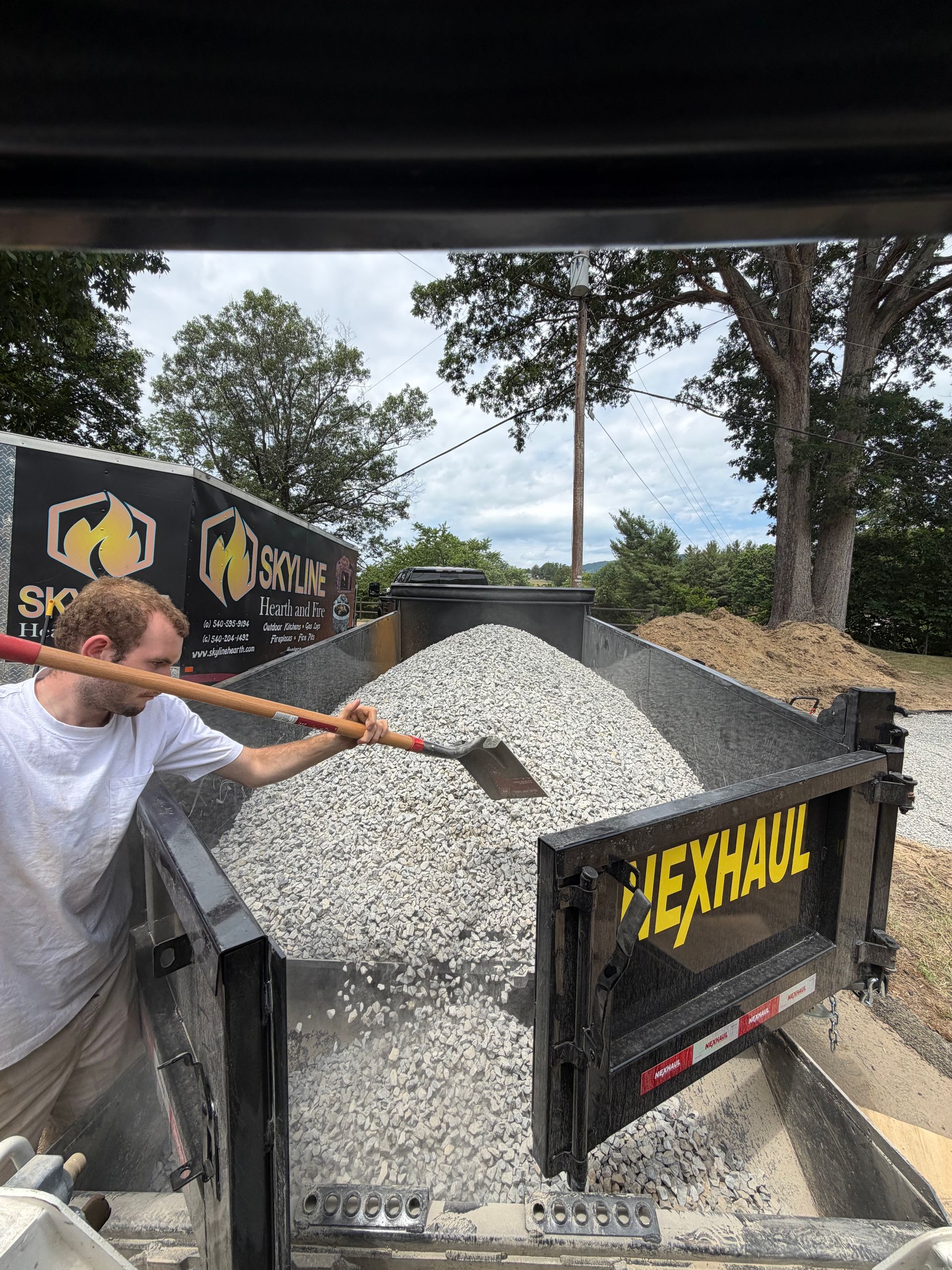
- Aggregate selection
- Geotextile
- Drainage pipe
- Surface grading
- Managing downspouts
- Managing surrounding runoff
Clay is not automatically a problem.
Ignoring clay can be.
What Does the Base Have to Do With Drainage?
A lot.
We recently covered the differences between dense-graded crusher run and open-graded stone bases because each system handles water differently.
A dense-graded base contains a range of aggregate sizes including fines.
When properly compacted, those fines help create a very stable base.
An open-graded system uses clean angular aggregate with larger interconnected voids.
Water can travel through those voids much more easily.
Neither automatically means:
Good drainage.
Because the real question is still:
Where does the water go after it enters the base?
You can install the most free-draining stone imaginable.
If you put it inside an excavation surrounded by slowly draining clay and give the water no outlet...
Congratulations.
You built a gravel bathtub.
What Is an Underdrain Beneath a Paver Patio?
An underdrain is typically a perforated pipe installed within or near the bottom of the aggregate base.
Its purpose is to collect water and carry it away from the pavement system.
An underdrain can be especially useful when:
- Native soil drains poorly
- The patio sits between structures
- Water naturally collects in the area
- An open-graded base is being used
- The site has limited natural drainage
- A retaining wall is part of the project
But once again, the pipe needs an outlet.
Installing 50 feet of perforated pipe and capping both ends isn’t drainage.
That’s just storing pipe underground.
Where Does Patio Drainage Pipe Go?
Ideally, drainage piping discharges somewhere lower than the patio.
Depending on the property, that may include:
- Daylighting into the yard
- A lower landscape area
- A drainage swale
- An approved stormwater system
- Another designed outlet
The correct answer depends entirely on the site.
One thing we do not want is to solve one drainage problem by creating another one.
Sending all the water directly onto your neighbor’s property isn’t exactly the neighborly move.
What About Downspouts Near a Patio?
This one is huge.
A downspout can dump an enormous amount of water in one concentrated location.
If a roof downspout empties directly beside a patio, that water needs to be dealt with before the hardscape is finished.
Options may include:
- Extending the downspout
- Running solid pipe beneath or around the patio
- Connecting to an approved drainage outlet
- Redirecting water to a lower part of the property
What we generally don’t want is:
Downspout → patio base → hope.
Hope is not a drainage system.
If we are designing a complete outdoor living space, roof runoff should be considered along with the patio, walls, steps, kitchen, fire features, and landscaping.
Can You Run Downspout Pipe Under a Paver Patio?
Yes, when it’s planned correctly.
In fact, if a downspout needs to cross the patio area, installing the drainage line before the base and pavers go in is obviously the time to do it.
Because cutting apart a brand-new patio three months later to install a drain line ranks fairly high on the list of:
Things we could have avoided.
Drain lines beneath hardscapes need to be properly installed and supported so they do not create settlement issues later.
Again, everything beneath the patio matters.
Do Paver Joints Let Water Through?
Some water can enter through paver joints, but how much depends on the pavement system and joint material.
A standard interlocking concrete paver patio is not automatically a permeable pavement system.
That is an important distinction.
Traditional pavers installed over a conventional base are designed primarily to shed surface water through slope.
True permeable pavement systems are intentionally designed to allow significant amounts of water to pass through wider joints and into a specially designed open-graded base.
Those are different systems.
Just because your patio has joints does not mean you can build it dead level and assume the rain is going to magically disappear through them.
It won’t.
What Is a Permeable Paver Patio?
A permeable paver system is specifically designed to allow stormwater to enter the pavement and move into a drainage or storage system underneath.
That typically involves:
- Permeable-style pavers
- Larger drainage joints
- Clean joint aggregate
- Open-graded bedding
- Open-graded base material
- Proper subgrade design
- Drainage or infiltration planning
That can be extremely useful in the right application.
But it is a completely different conversation from a traditional paver patio.
You don’t turn regular pavers into permeable pavement by leaving bigger gaps and crossing your fingers.
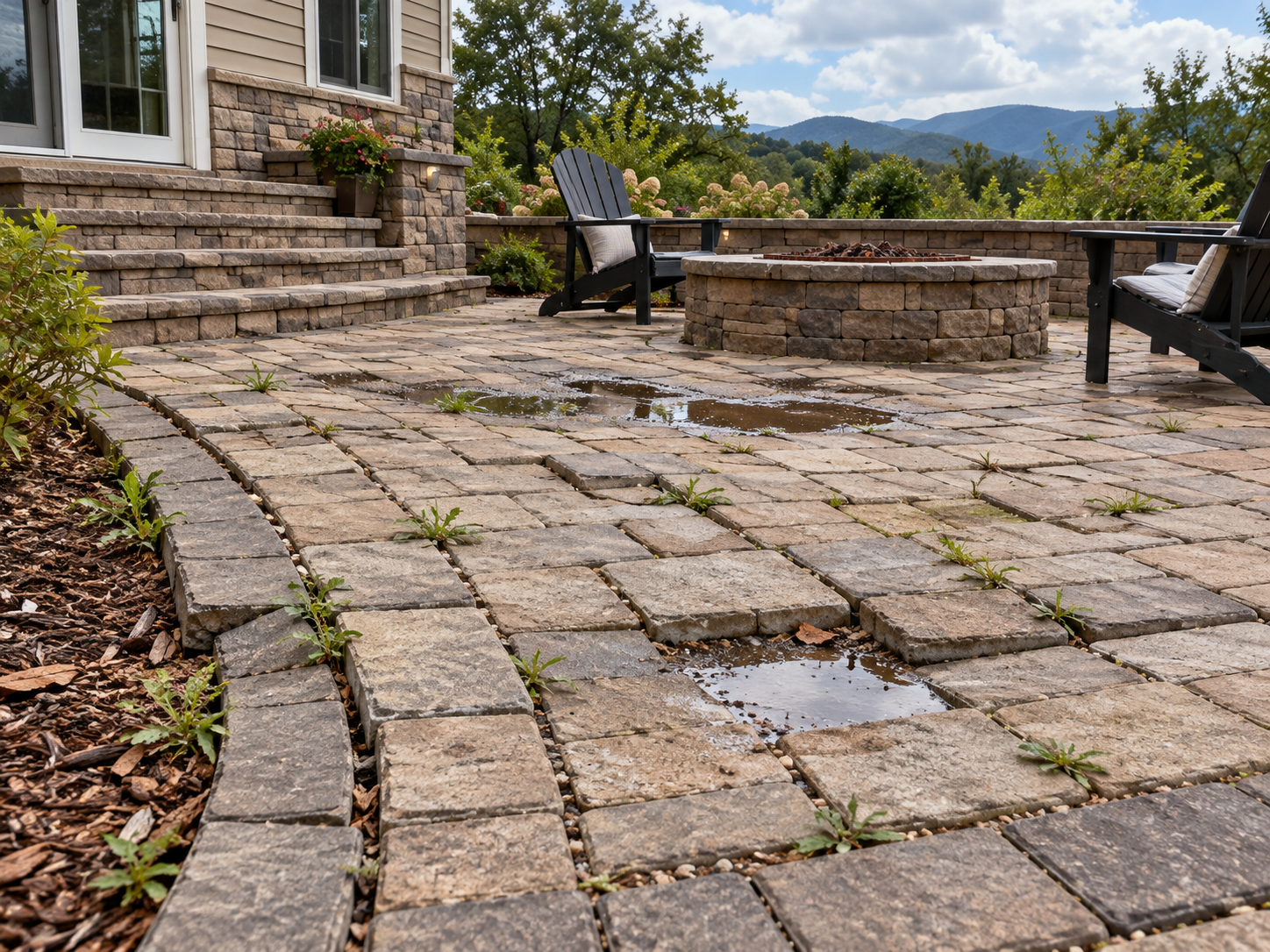
What Causes Standing Water on a Paver Patio?
Several things can cause puddles or low spots.
Improper Slope
If the patio does not have enough pitch, water has nowhere to move.
Low Spots in the Surface
Poor screeding, settlement, or base inconsistencies can create depressions.
Base Settlement
If the aggregate or subgrade settles unevenly, the pavers settle with it.
Poor Edge Drainage
The patio may slope correctly but terminate against a curb, wall, or landscape edge that traps water.
Existing Grade Problems
Sometimes the patio is actually lower than the surrounding yard.
Now the patio has become the drain.
Not ideal.
Blocked Drainage
Leaves, sediment, mulch, or debris can block drainage channels and outlets.
Poorly Managed Roof Runoff
A nearby downspout can overwhelm the area.
Can a Paver Patio Drain Toward the Lawn?
Absolutely.
In many projects, that is the simplest and best solution.
If the lawn is lower than the patio and has enough pitch to continue carrying water away, the patio can drain directly toward the yard.
The transition matters, though.
You don’t want:
Patio.
Three-foot strip of grass.
Swamp.
The entire drainage path needs to work.
What Happens When the Yard Is Higher Than the Patio?
Now we have something to talk about.
If the yard slopes toward the patio, surface water may run directly onto the pavers.
That can require additional drainage measures.
Depending on the site, that could include:
- Regrading
- Swales
- Trench drains
- Catch basins
- Drainage stone
- Retaining walls
- Surface drains
- Landscape modifications
Sometimes a retaining wall is necessary to change the grade and create a usable patio elevation.
Other times, a smaller drainage solution can handle it.
The important part is identifying the problem before we build the patio.
What Is a Channel Drain?
A channel drain, sometimes called a trench drain, is a linear surface drain designed to collect runoff across a larger area.
You’ll often see them:
- Along garage entrances
- Between patios and buildings
- At the bottom of slopes
- Along pool decks
- Where two hardscape surfaces meet
- At transitions where water cannot simply run into the yard
Channel drains can be extremely useful.
They can also be extremely ugly if they are dropped into a project as an afterthought.
Good drainage should work.
Really good drainage should work without looking like somebody panicked halfway through the job.
Can a Patio Be Built Against Existing Concrete?
Yes.
But existing concrete creates another fixed elevation.
That means we now have to make the patio work with:
- House door thresholds
- Existing slab elevation
- Yard elevation
- Drainage direction
- Paver thickness
- Bedding thickness
- Base depth
The more fixed elevations on a project, the less flexibility we have.
This is where proper elevation planning becomes critical.
If the patio needs to connect to an existing concrete porch, driveway, sidewalk, or slab, that needs to be evaluated before excavation begins.
The pavers do not get to vote on the final elevation.
Gravity has already filled out the ballot.
What About Patios Next to Driveways?
Driveways can create major drainage issues because they collect and move a large amount of water quickly.
If the driveway slopes toward the backyard or patio, we need to know that.
Otherwise every thunderstorm can send a fresh delivery of water directly into the outdoor living area.
Depending on the property, that may require:
- Channel drains
- Grade changes
- Drain piping
- Swales
- Retaining walls
- Strategic patio elevation
Again, this is why a patio project should not be designed in isolation.
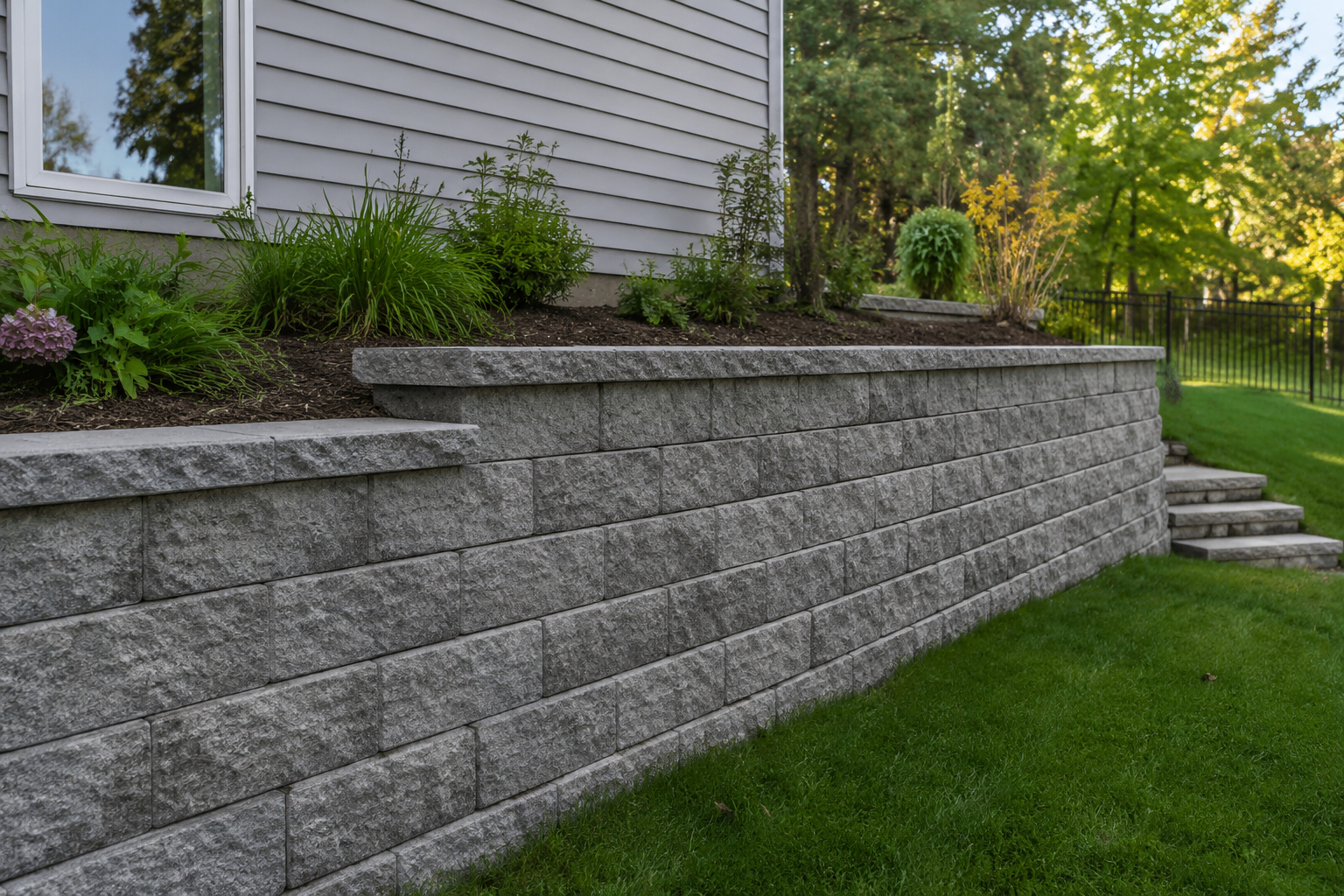
Do Retaining Walls Affect Patio Drainage?
Absolutely.
Retaining walls and patios often work together.
A wall may be needed to create a level area for the patio.
But now the wall needs its own drainage system too.
So we may have:
- Water draining off the patio
- Water moving through the patio base
- Water behind the retaining wall
- Water coming down the slope above the wall
All happening in the same project.
That needs to be thought through as one system.
If you’re considering a wall as part of your backyard project, our guide to retaining wall costs in Roanoke, VA explains some of the factors that make these projects more involved than simply stacking block.
Should Patio Water Drain Over a Retaining Wall?
Sometimes water can safely drain toward landscaping near a wall.
But intentionally sending concentrated runoff over the top or behind a retaining wall without a plan is a different story.
That can lead to:
- Erosion
- Washout
- Soil movement
- Staining
- Water pressure behind the wall
- Damage to landscaping
If surface water needs to cross or move through a retaining wall area, it should be handled intentionally.
Not creatively during the first thunderstorm.
Why Proper Excavation Matters for Drainage
The excavation determines the shape of the entire pavement system.
If the bottom of the excavation has random low spots, those areas can collect water.
If the base is installed with no consideration for drainage, water can become trapped underneath the patio.
If the surrounding soil is higher than the base, runoff can potentially migrate into the excavation.
The base and subgrade need to be thought of as part of the drainage design.
That’s why we don’t just dig until somebody says:
“Looks deep enough.”
Depth matters.
Elevation matters.
Slope matters.
Can Landscape Fabric Fix Drainage Problems?
No.
Geotextile can be an important part of a paver installation, especially for separation between aggregate and fine soils.
But fabric is not a drainage plan.
It does not magically make clay drain.
It does not replace proper slope.
It does not replace drain pipe.
It does not fix poor grading.
Geotextile does a specific job.
Asking it to solve everything is like handing a screwdriver to a plumber and saying:
“You’re good, right?”
Maybe.
But probably not.
What About French Drains Around a Patio?
French drains can be useful when groundwater or surface runoff needs to be intercepted before it reaches the patio.
A typical French drain may include:
- Perforated pipe
- Clean drainage stone
- Geotextile
- A properly graded trench
- A discharge location
But French drains are not automatically the answer to every wet backyard.
Sometimes the problem is simply poor surface grading.
Sometimes it’s a downspout.
Sometimes it’s runoff from the neighbor’s hill.
Sometimes it’s groundwater.
Good drainage starts by identifying where the water is actually coming from.
Otherwise we’re just burying expensive pipe and hoping we guessed correctly.
Should You Install a Patio Over a Wet Area?
Not without fixing the reason it is wet.
If an area stays soft or saturated, covering it with pavers doesn’t make the problem disappear.
It just makes the problem harder to see.
The cause should be evaluated first.
That might include:
- Poor grading
- Groundwater
- Roof runoff
- Downspouts
- Underground springs
- Drainage from nearby properties
- Compacted clay
- A low spot in the yard
A patio can often still be built there.
But the wet condition needs to become part of the design.
Why Paver Patios Sink Near Downspouts
This is one of those problems that makes perfect sense once you see what is happening.
A downspout repeatedly dumps water beside the patio.
The soil becomes saturated.
Fine material moves.
The edge or subgrade softens.
Eventually the pavers begin settling.
Then the new low spot collects even more water.
Now we’ve created a beautiful little feedback loop of misery.
The better option is managing the downspout correctly from the beginning.
Why Water Pools at the Edge of a Patio
Sometimes the patio itself has enough slope.
The problem is what happens at the end.
For example:
The patio slopes toward the grass.
Great.
But the grass is two inches higher than the edge of the patio.
Now the water hits the lawn and says:
“Well, guess we live here now.”
Finish grading around a patio matters.
The surrounding lawn or landscape should allow water to continue moving away from the pavement.
Does Polymeric Sand Make a Patio Waterproof?
No.
Polymeric joint sand helps stabilize joints and resist erosion, insects, and weed growth when properly installed.
But it does not turn a standard paver patio into a waterproof slab.
Water management still relies heavily on:
- Surface slope
- Base construction
- Drainage
- Surrounding grade
Joint sand is one piece of the system.
It is not tiny waterproof grout.
Can Poor Drainage Cause Polymeric Sand Problems?
Absolutely.
If water repeatedly collects on the patio or flows aggressively through joints, joint material can suffer.
Possible issues include:
- Washout
- Erosion
- Softening
- Joint deterioration
- Discoloration
- Premature failure
Again, the solution isn’t necessarily:
More sand.
If the drainage problem isn’t fixed, you may simply be replacing the symptom.
What About Freeze-Thaw Damage?
Water and freezing temperatures are not exactly best friends.
When water becomes trapped in soil or pavement systems and freezes, expansion can contribute to movement.
The good news is that properly designed paver systems can perform extremely well in freeze-thaw climates.
But proper design still matters.
That means:
- Stable subgrade
- Correct base
- Drainage
- Proper compaction
- Appropriate materials
Virginia winters may not look like Minnesota, but we absolutely get freeze-thaw cycles.
Usually during the same week we were wearing shorts.
How Do You Fix Standing Water on an Existing Paver Patio?
That depends on why the water is standing.
Possible repairs may include:
- Lifting and regrading the pavers
- Correcting a settled base
- Installing a drain
- Regrading the surrounding lawn
- Redirecting downspouts
- Adding a channel drain
- Correcting edge elevations
One advantage of pavers is that problem areas can often be disassembled and rebuilt.
Unlike a monolithic concrete slab, we may not need to demolish the entire patio just because one section has settled.
But the cause still needs to be fixed.
Otherwise the low spot will probably come back for the sequel.
What Should You Ask a Paver Contractor About Drainage?
If you’re getting quotes for a patio, ask:
Where is the water going?
That one question can tell you a lot.
Also ask:
- Which direction will the patio pitch?
- How will you handle my downspouts?
- What happens to water coming from uphill?
- Will drainage pipe be needed?
- How will the patio tie into the lawn?
- What happens where it meets existing concrete?
- How will retaining walls affect drainage?
- What base system are you using?
- How are you handling clay soil?
If the answer to all of that is:
“Don’t worry about it.”
Well...
We would probably worry about it.
Paver Patio Drainage on Sloped Properties
Some of the best outdoor spaces come from difficult properties.
A steep or uneven backyard does not automatically mean you cannot have a patio.
It may simply require more planning.
A sloped property can sometimes be transformed using:
- Retaining walls
- Terracing
- Steps
- Multi-level patios
- Drainage systems
- Swales
- Strategic grading
We’ve worked on projects where the grade determines nearly every design decision.
That can make the project more complicated.
It can also make the finished transformation much more dramatic.
Drainage Should Be Designed Before the Patio
This really is the main point.
Drainage isn’t the thing we add when the patio is almost finished and somebody notices water has nowhere to go.
It starts when we first look at the property.
Where is the high point?
Where is the low point?
Where does the roof water go?
Where does the yard water come from?
Where are the doors?
Where is the existing concrete?
Where might a retaining wall go?
Where can drainage safely discharge?
Those questions determine the finished patio elevation.
And the finished patio elevation determines almost everything else.
Paver Patio Contractor in Roanoke, VA
Skyline Hardscapes & Premier Outdoor Living designs and installs custom paver patios and complete hardscape projects throughout Roanoke and Southwest Virginia.
We serve homeowners throughout:
- Roanoke
- Salem
- Vinton
- Bedford
- Smith Mountain Lake
- Moneta
- Daleville
- Botetourt County
- Blacksburg
- Christiansburg
- Lexington
- Lynchburg
- Forest
- And surrounding communities
Our projects can include:
- Paver patios
- Retaining walls
- Walkways
- Steps
- Fire pit areas
- Seating walls
- Landscape lighting
- Outdoor kitchens
- Complete outdoor living designs
If you’re still figuring out the budget side, our 2026 paver patio cost guide for Roanoke, VA breaks down the major factors that affect patio pricing.
Ready to Build a Patio Without Creating a Backyard Swimming Pool?
A good paver patio should give you a place to grill.
Relax.
Sit around the fire.
Have friends over.
Drink coffee.
Whatever you want to do out there.
It should not require you to check the radar every time you put the furniture out.
If you’re planning a paver patio or complete outdoor living project in Roanoke or Southwest Virginia, contact Skyline Hardscapes & Premier Outdoor Living to schedule a free in-home design consultation.
We’ll look at the patio.
We’ll look at the yard.
We’ll look at the elevations.
And most importantly...
We’ll figure out where the water is going before the water figures it out for us.
Skyline Hardscapes & Premier Outdoor Living
A division of Skyline Hearth & Fire
Done Right.